The American Eagle stock dropped by 11%
American Eagle Apparel released its earnings forecast, predicting that the quarterly gross margin would remain at the previous level. The sales of the main brand with the same name were sluggish, and the inventory was overstocked. As a result, the company's stock price plunged by about 11% in a single day.

The company's earnings were below market expectations, sending the stock price down sharply.
During the US stock market session, American Eagle stock plummeted with losses nearing 11%. The trigger for the market's fluctuation was the company's quarterly gross profit margin forecast. The market originally expected the gross profit margin to recover and increase, but the company provided guidance that the gross profit margin for this period would remain basically the same. To dispose of unsold goods, the brand could only increase discounting, directly squeezing the profit margin.
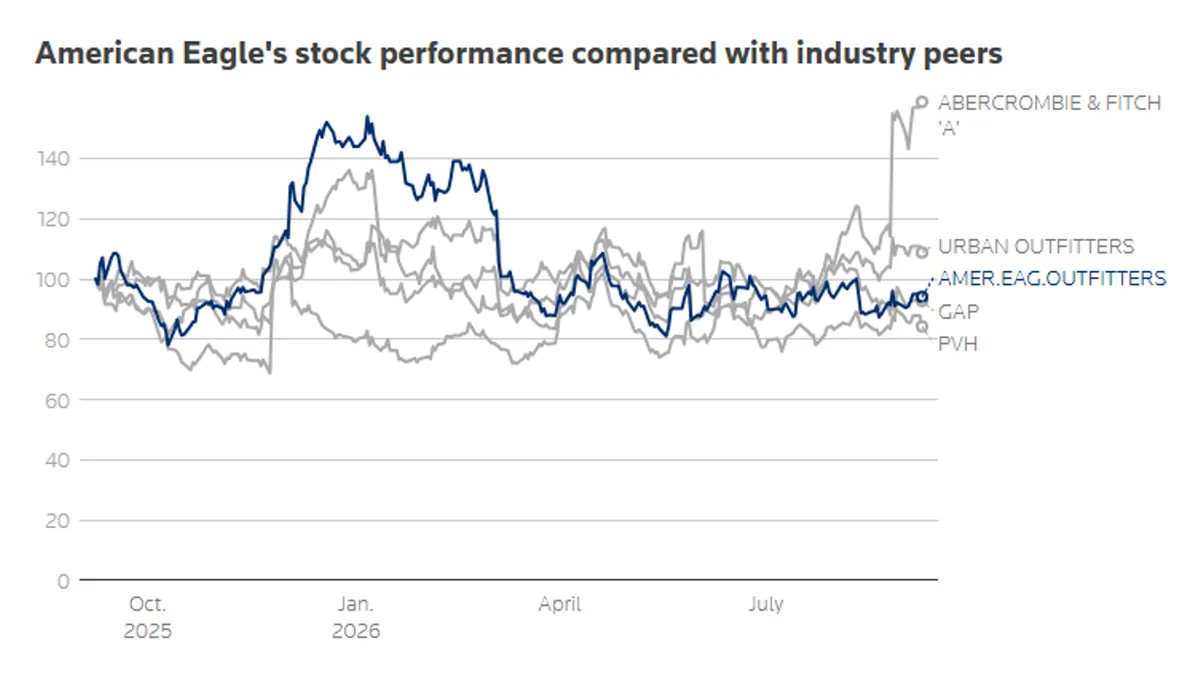
Although the revenue data for the just-ended second quarter was better than market expectations, the management did not raise the full-year comparable sales target and maintained the original forecast unchanged. The imagination space for future growth of funds was compressed. Since the beginning of this year, the stock's trend has remained weak, and the stock price has cumulatively dropped by about 36% this year. The whole of the clothing retail industry is in a situation of volatile consumer demand.
Aerie helped support the overall market, while the flagship brand AE trailed behind.
The American Eagle brand group has two independent brand lines. The operating conditions of the two brands are completely opposite. The lingerie and sportswear brand Aerie has consistently strong market demand and stable sales growth, and is a profit pillar within the group. However, the main brand American Eagle, which is the same name, is under pressure in its operation. The core category of women's jeans for the main brand has an uneven demand performance.
The market trend changes rapidly. Low-waist jeans suddenly became popular. The brands' previous stock of pants types were no longer popular, and a large number of products became unsalable inventory. The company launched marketing projects to try to turn the situation around, increased investment in denim products, and invited actress Sidney to collaborate and launch the "Great Jeans" series of advertisements, aiming to capture the young consumer group of Generation Z. Even with a large amount of marketing resources invested, the market competitiveness of the denim category still failed to catch up with its peers.
Inventory pressure combined with tariff costs have put significant pressure on the company's profit margins.
In the latest quarter ending on August 1st, the company's inventory costs rose by 14% year-on-year. Among the new costs, there were additional expenditures due to tariffs. The fashion industry has a fast pace of trend changes, and once the styles fail to keep up with the popular trends, the inventory will depreciate. To clear the inventory, enterprises can only sell at discounted prices. The more discounts, the harder it is to increase the gross profit margin. The continuous increase in inventory means that in the coming period, enterprises will find it difficult to stop promotions, and the profit recovery cycle will be prolonged. If combined with the increase in purchase costs due to tariffs, the difficulty of profit recovery will further increase.
Industry competitor comparison.
Last month, competitors Abercrombie & Fitch raised their full-year sales and profit expectations, and the growth prospects were well-received by the market. Gap released its financial report, with quarterly performance exceeding market expectations, and simultaneously raised its full-year profit guidance. Both in the youth casual clothing sector, peers were able to achieve growth, while American Eagle was deeply trapped in the weakness of its main brand.
The current price-to-earnings ratio of American Eagle is 9.38 times, Abercrombie & Fitch's is 11.47 times, and Gap's is 8.91 times. Abercrombie & Fitch is more highly valued and with more certainty of profit growth. Gap may be cheaper, but expectations for the company are positive. American Eagle is stuck in the middle with the main brand weighing it down and the market not willing to give it a premium to value. Overall sentiment in the sector got a lift on the day of the disclosure, as Abercrombie & Fitch's stock price dropped about 3% and Gap's about 2%.