US debt and inflation led to a collective decline in the three major US stock indices
US debt yields on various maturities hit record highs in recent years. Oil price surge has pushed up inflation expectations and increased the odds of interest rate hikes. The US stock market has seen a broad correction.
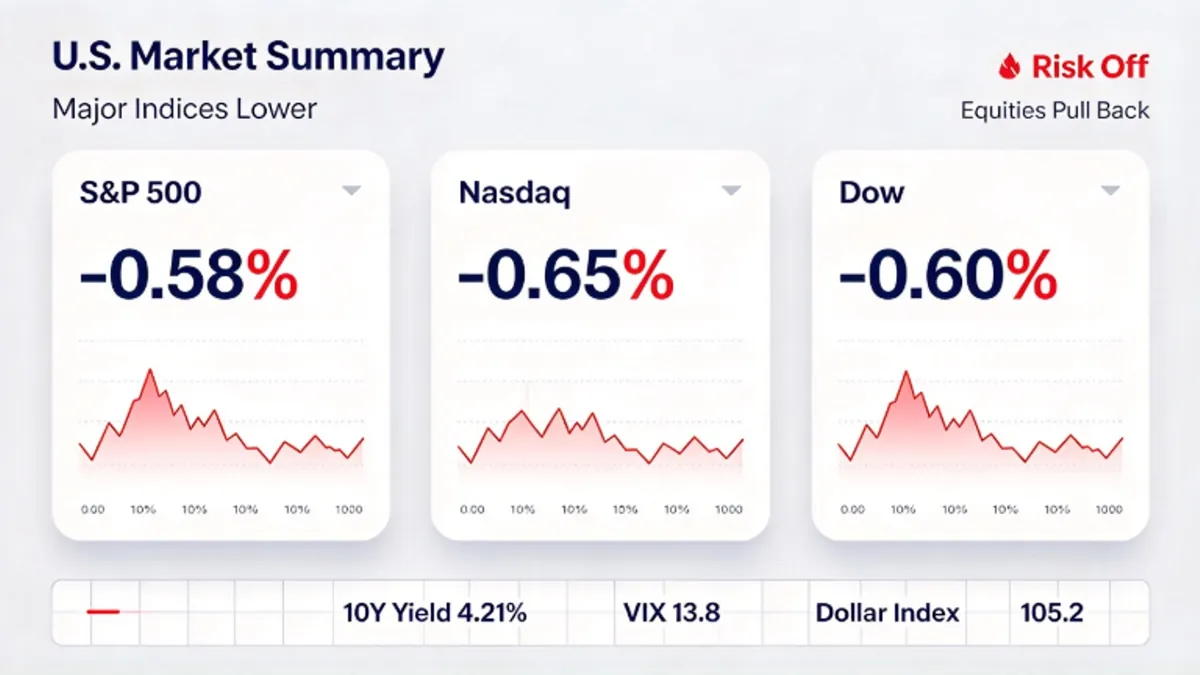
The US stock market fell everyplace.
The three major mainstream US stock market indices finished lower on Thursday. The S&P 500 index declined 0.58% to end at 7,591.75 points. The Nasdaq index was off 0.65% and the Dow Jones Industrial Index dropped 0.60%. The trading volume of US stocks on that day was 1.51 billion shares, slightly higher than the average of the past 20 trading days. The S&P 500 has fallen 2% over the last four trading days, its worst four-day drop since June.
The ratio of declining stocks to rising stocks was 2:1, with far more stocks declining than rising. The forces of buy and sell were completely in favor of the sellers, and the overall profit effect of the market was low. The performance of the sub-indexes was highly polarized. Within the S&P 500, only two industry sectors rose, while the remaining nine sectors all declined. The materials sector led the decline across the market, with a single-day drop of 1.45%, followed by the information technology sector, which fell by 0.91%.
The yields of US debt have soared across the board, suppressing the overall valuation of the stock market.
The 10-year US Treasury yield reached its peak since 2023, the 30-year yield hit a 19-year high, and the 2-year yield also reached a new high in over two years. The reasons for the rise in yields of different maturities are different, and they exert a double pressure on the stock market. The short-term yield increase is due to the rising expectations of interest rate hikes in the market, with funds anticipating that the Federal Reserve will likely tighten monetary policy next week. The long-term yield rise is compounded by multiple factors such as the high US fiscal deficit, debt scale and stagflation risks.
The rise in Treasury yields directly affects the pricing of the stock market. On one hand, the increase in the risk-free interest rate raises the financing costs for enterprises, reducing their profit margins. On the other hand, the attractiveness of high-yield Treasuries increases, causing a large amount of risky capital to shift from the stock market to the bond market, diverting the additional funds from the stock market. At the same time, the increase in the discount rate lowers the forward valuation of growth stocks, largely impacting the core technology sectors of the US stock market.
The sharp increase in oil prices combined with the PPI data has led to a continuous rise in the expectation of interest rate hikes.
In August, the US PPI data rose as expected on a month-on-month basis. The rebound in energy prices was the core driving factor, and inflationary pressure in the industrial sector rose again. The turmoil in the energy market has further exacerbated inflation concerns. The outbreak in the Middle East has disrupted shipping routes in the Strait of Hormuz and the Red Sea, putting pressure on global crude oil supply. Brent crude oil soared by 6% in a single day, stabilizing at $107 per barrel. The increase in energy prices directly intensified market concerns about runaway inflation.
The CME Federal Reserve Watch tool shows that the probability of a 25 basis point or more interest rate hike next week has risen to 70%, significantly higher than the previous 64%. The market has completely entered the interest rate hike pricing mode, and risk assets have collectively come under pressure. The current market focus is entirely on the upcoming August CPI data to be released on Friday. The inflation data in the consumption sector will ultimately determine the policy direction of the Federal Reserve's meeting next week and will directly determine the short-term rise and fall rhythm of the US stock market.
The stocks within the sector have shown significant divergence.
The internal performance of the technology sector has been polarized. The AI chip giants have significantly weakened, dragging down the index performance. Nvidia opened the day with a 2.3% decline, and Micron Technology dropped by as much as 4.7%. Apple has emerged with an independent performance, becoming one of the few strong stocks. The company's stock price climbed 3.6% the day it launched the $1,999 foldable iPhone.
The traditional consumer sector also has been poor. Department store Macy's raised its full-year performance guidance slightly but the increase fell short of what the market had expected. Investors' confidence was lacking, and the stocks opened down by 4.7%. The clothing retail stock American Eagle performed even worse, plunging by 14% on the same day, hitting a new low since October. The weak consumer demand combined with industry competition pressure has led to continued capital flight from consumer stocks.
The current trading logic of the US stock market has completely changed. It has shifted from being driven by earnings in the past to being dominated by macro policies and inflation expectations. The market is now looking beyond corporate profits and pricing in three main variables - US bond yields, inflation data and the pace of Fed interest rate hikes.