Several leading brokerage firms have released the 2026 target prices for the S&P 500 index
The big brokerages have set forth their target points for where the S&P 500 index will be at the end of the year. Much of the AI profit growth was expected but the geopolitical conflicts in the Middle East and energy disruptions have become wildcards.
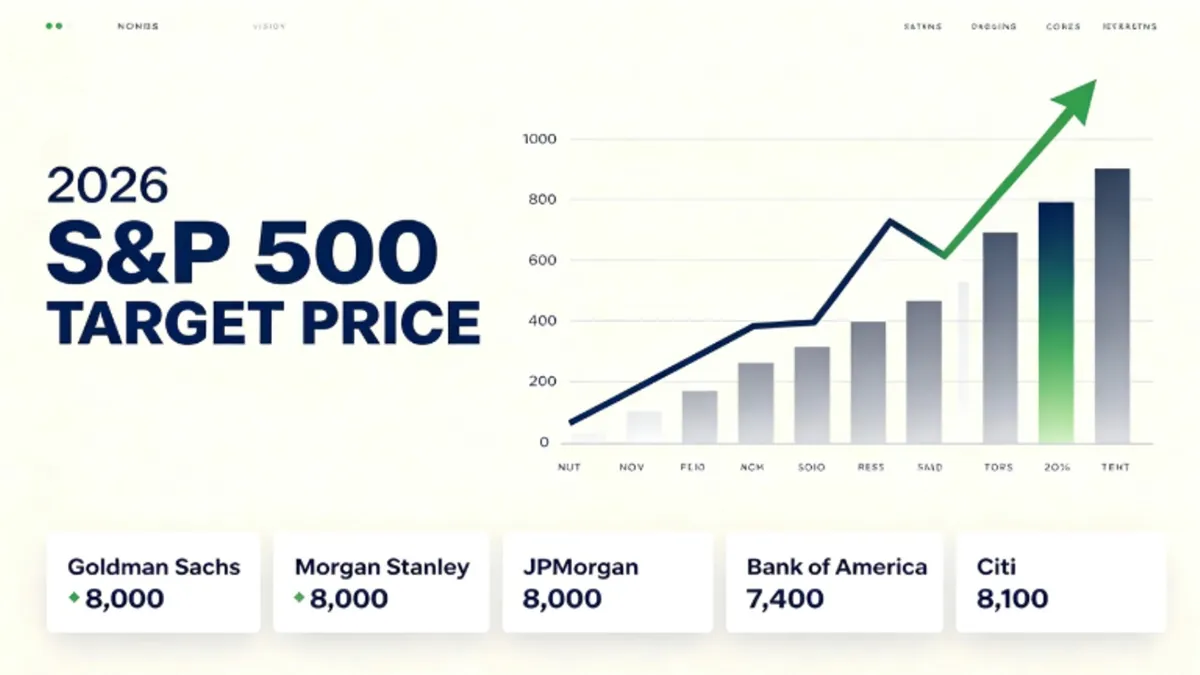
The range of target prices for institutions has widened, and market expectations have become differentiated.
The main expectations for the US stock market in 2026 are gradually becoming clear. Several major global securities firms have successively updated the end-year target points for the S&P 500 index. The judgments of each firm are not uniform. The lowest estimate is 7,400 points, while optimistic institutions expect it to reach 8,100 points. The lowest target in this list is from BofA Global Research, which is relatively conservative at 7,400 points. Jefferies and BNP Paribas have given 7,500 points. Wells Fargo has given 7,700, and Barclays has raised it to 7,950.
Many well-known institutions have directly set their targets at the 8,000-point mark. JPMorgan Chase, Deutsche Bank, BNP Paribas, Goldman Sachs, Morgan Stanley, all have their year-end targets set at 8,000. UBS Global Research, Goldman Sachs Asset Management, Citigroup, UBS Global Wealth Management and HSBC are even more optimistic, seeing the target at 8,100.
It should be noted that UBS Global Research and UBS Global Wealth Management are independent business divisions within the group. Although both belong to UBS, their research teams are separate and each issues their own opinions independently. The Wells Fargo Investment Institute is a wholly-owned subsidiary of Wells Fargo. The viewpoints of this institute differ from those of the bank's main research team, which is why there will be two different sets of targets. These point predictions are not fixed and there is room for change.
The AI industry drives up corporate profits.
Most institutions are optimistic about the S&P 500, and the main reason is the improved profitability brought by the AI sector. The weight of the US stock index is highly concentrated on large technology companies. These companies invest in computing power, large models and AI software, and their related businesses are contributing more and more profits. Institutions estimate that the profit growth brought by AI is sufficient to offset some external negative impacts.
When institutions conduct valuation calculations, they will incorporate the profit growth rate of AI into the model. As long as the earnings expectations of technology companies can be verified in the financial reports, the upward logic of the S&P 500 can be maintained. However, institutions are not blindly optimistic. The AI market is not without variables. If the revenue conversion to profits of enterprises is lower than expected, then the profit expectations will be lowered, and the target points will also be adjusted accordingly.
The geopolitical conflicts in the Middle East have caused continuous disruptions.
AI profitability is the main positive factor, but almost all institutional reports will mention the risks of the situation in the Middle East. Geopolitical conflicts lead to chain reactions. The prices of crude oil and natural gas tend to rise sharply, pushing up the global inflation level. The obstruction of energy flow will increase the production costs of enterprises and also change the monetary policy path of the Federal Reserve. Once inflation rebounds, the expectation for interest rate cuts will be delayed or even restarted, and the valuation of US stocks will be under pressure.
In the scenario analysis of the institution, two scenarios will be set. One is that the conflict can be controlled, with minor fluctuations in energy prices and an AI-driven market where profits dominate. The index can move above 8,000 points. The other is that the conflict escalates, with soaring oil prices, rebounding inflation, and increased enterprise costs. The upward potential of the stock market is compressed, corresponding to a more conservative target price. More conservative institutions such as BofA Global Research factor in more geopolitical and inflation risks, so their target points are lower.
The gap between target points is significant. The essence lies in the fact that different institutions have different judgments on the macro environment and valuation tolerance. The 8,000-point mark is an important psychological threshold. Many leading institutions simultaneously set the target at 8,000. This position then becomes the consensus center of the market.
The research systems of different institutions are different. Investment banks mainly target institutional clients and their predictions have the function of guiding market expectations. The viewpoints of the asset management department are more focused on the practical level and will combine their own holdings to judge the market space. Just like Goldman Sachs and Goldman Sachs Asset Management, even within the same group, different judgments may occur.