Nike's stock price has plummeted severely and has been removed from the S&P 100 index
Nike's stock price has continued to decline sharply and has been excluded from the S&P 100 index. Its Dow Jones weighting is the lowest, and the market generally predicts that it is highly likely to be removed from the blue-chip index.

Nike was removed from the S&P 100 Index.
The S&P Dow Jones Indices Company announced that Nike officially withdrew from the S&P 100 Index before the market opened on September 21. This was Nike's first removal from the index after it had held the position for 18 consecutive years. This index removal was not a sudden adjustment. In the past five years, Nike's market competitiveness has declined, its product innovation and iteration have been slow, its revenue growth has been weak, and its market value has plummeted by 80%, completely losing the qualification for being a component stock of the S&P 100 Index.
The market's attention quickly focused on its other core identity - a component stock of the Dow Jones Industrial Average Index. As a benchmark index with a century of history, the Dow Jones component stocks represent the top-quality enterprises of the US stock market. Nike's current business operations and stock performance have long been seriously inconsistent with the index's positioning, and the risk of being removed has sharply increased.
The company's multiple indicators have reached the worst level in this period.
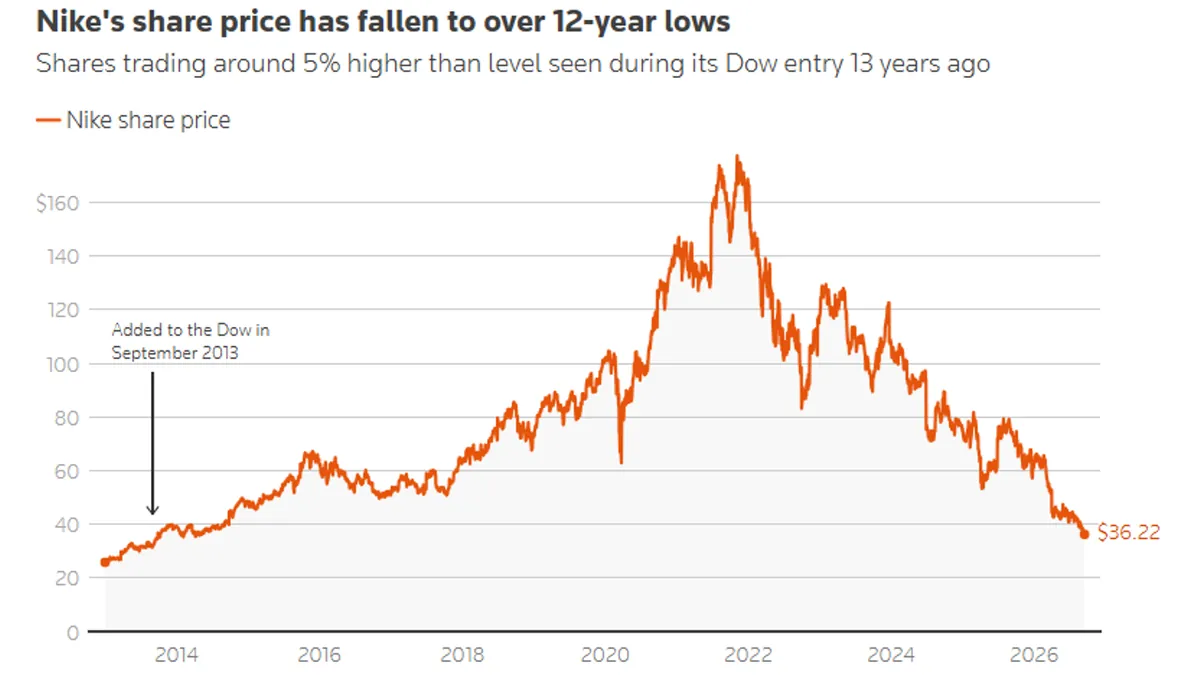
Nike's recent stock price has remained at around $36, with an annual cumulative decline of over 43%, setting a new low for its stock price in the past 12 years. It is the worst-performing stock among the 30 components of the Dow Jones Index this year. Since being included in the Dow Jones Index in 2013, Nike's stock price has only risen slightly by 5%. Its extremely poor performance over an extremely long period has completely lost the patience of institutional investors.
Under the Dow Jones price-weighted mechanism, Nike's current weight is only 0.4%, firmly ranking at the bottom of the 30 components, and is the least influential stock in the index. Currently, the stock price of Goldman Sachs, which has the highest weight in the Dow Jones Index, is nearly $968, which is 27 times that of Nike. The extreme disparity between the two is huge. In all previous adjustments of the Dow Jones Index components, more than half of the cases involved the removal of the stocks with the smallest weight and the poorest performance at that time. Nike currently fully meets this characteristic.
The Dow Jones index has special rules with no fixed elimination threshold.
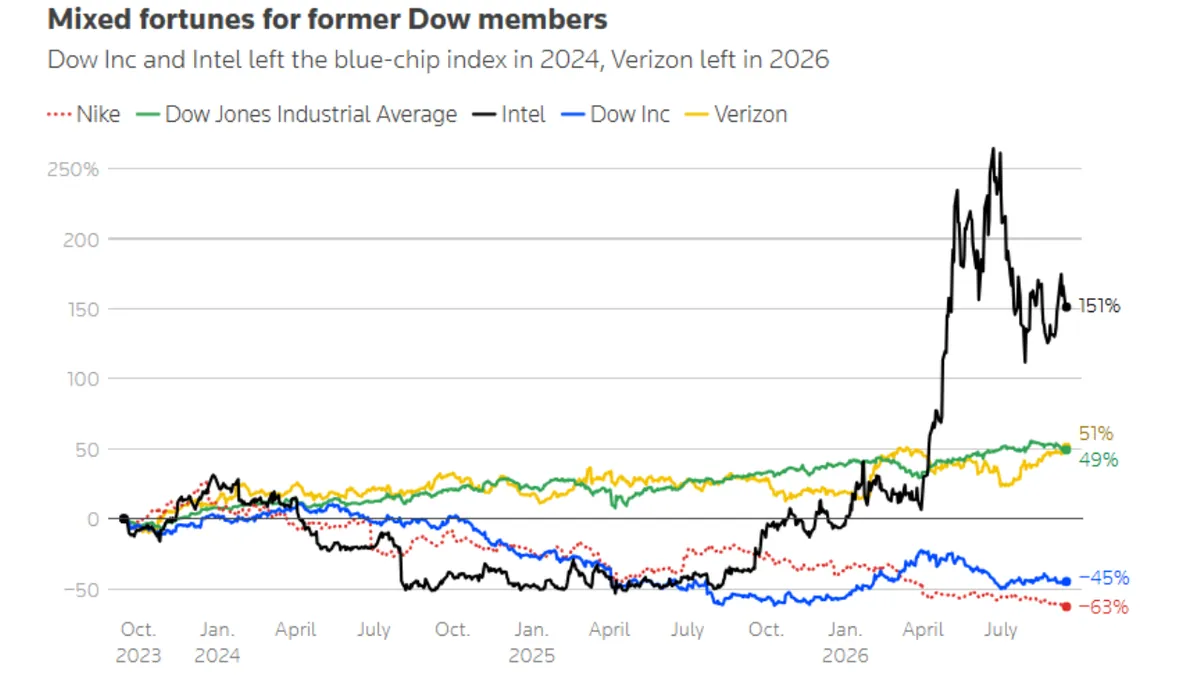
Unlike the S&P 500 and Nasdaq 100, which determine membership based on market capitalization and trading volume, the Dow Jones index adopts a stock price weighting model and has no standardized elimination clauses or fixed adjustment cycles. As long as there is a significant change in the performance of the constituent stocks, the committee can initiate an adjustment at any time. Previously, companies such as Intel and Dow were temporarily removed due to long-term low stock prices. This also makes the elimination time of Nike unpredictable, and an adjustment could occur at any time, bringing great uncertainty to the invested funds.
The business has deteriorated completely, and the index has dropped due to expectations of a recovery.
Nike in 2024 underwent a major self-recovery transformation, but the results were not significant. The macro environment is complex and consumers are still reluctant to buy non-essential items. The sales at the terminal level are facing numerous obstacles. Over the past five years, Nike failed to drive growth with new best-selling products, the appeal of classic styles declined, and it was unable to attract the mainstream young consumer group. Competitors in the industry quickly seized the market, and Nike's industry influence weakened.
Except for a few core markets, Nike has found it increasingly difficult to attract consumers relying on its brand advantage. The brand premium has gradually declined, the foot traffic in its stores has dropped, and discount promotions have become the norm, further compressing the profit margin. The changes in the consumption environment have increased the operational pressure of Nike. Inflation influences the consumption decisions of the inhabitants, and the general population reduces non-essential spending such as clothing and sporting goods.
Previously, the market regarded Nike as a stable blue-chip stock and a long-term investment target. Now, it has completely turned into a risky investment option. Once Nike is removed from the Dow Jones Index, passive index funds will be forced to sell in large quantities, and the massive selling pressure will further depress the stock price, initiating a new round of downward trend. At the same time, the loss of its status as a blue-chip index stock will completely shatter the market's expectation for its valuation recovery.